How it works
Teach Bert.
Parlor Kids turns the usual reading app around. Your child isn’t tested on the chapter. They explain it to Bert, who read it too and got a few things muddled.

Who’s who
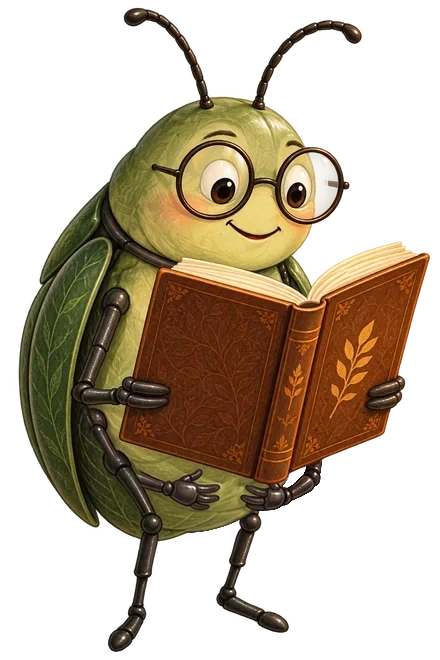
Bert the Book Beetle
Loves books but doesn’t always read carefully. He’s the one who needs help.

Danny the terrier
The listener: when your child wants to tell Bert something, they tap or hold Danny’s paw and talk. Danny reacts, but he never chats.
A session, step by step
Guess, read, put Bert right, bedtime.
- 1
A guess before reading
Before a new chapter, Bert shows its title and asks what your child thinks will happen. They can tell Danny, or just start reading. After the chapter, Bert compares the guess with what happened in the book (“Part of your guess happened!”), or, when he can’t tell, plays the guess back and asks your child.
- 2
Reading the chapter
The chapter opens as a book: pages that turn, the original illustrations where the book has them, and type sized for the screen. Children who read on their own read it themselves. For ages 5 to 7 there’s a reading mode for a grown-up to read the chapter aloud, and then your child teaches Bert.
- 3
Bert’s mix-ups
Bert has written a note about the chapter, and part of it is wrong. Children 5 to 10 pick what really happened: from two versions at 5 to 7, from three at 7 to 10. Children 10 to 12 explain it in their own words, typed or said. From the first chapter of The Wonderful Wizard of Oz:
From chapter 1 of The Wonderful Wizard of Oz
BertI think Aunt Em went to look after the animals when the cyclone came. Is that right?
Your childIt was Uncle Henry. He went to look after the animals.
When a child explains, Bert checks whether what they wrote or said is closer to the book or to his mistake. If it’s closer to the book, he has his “aha”. If it sounds like his mistake, he opens the book at the right sentence. Either way, he shows the line he’d write in his notebook and asks your child to check it before he writes it down.
Help, only when asked:The pageThe sentenceTwo versions (10 to 12)
Bert never says your child is wrong and never praises them. His “aha” is the reward: the window opens and the fly gets out.
- 4
Bert’s notebook
Everything your child teaches Bert goes into his notebook. It’s a record of the chapters you’ve read together, in Bert’s words, and it’s what you see when you look at your child’s progress. A few days after something took a second try, Bert gets it muddled again, and your child reminds him (“Bert forgot”): remembering later is how reading sticks.
- 5
Bedtime
When the chapter is done, the lamp goes down and Bert goes to sleep. A session is meant to take 5 to 10 minutes. There’s no streak to keep and nothing pulling your child into the next chapter.
Questions instead, or as well
For each child you can choose what happens after a chapter: helping Bert (the default), answering questions about the story, or both. The questions are about the book (who, where, why). Children 5 to 10 pick an answer; children 10 to 12 write or say it, and Bert compares it with the book. If it doesn’t match, he opens the book at the sentence and asks, “Was your answer like that?”
Questions about your child’s own life are never Bert’s. A chapter can end with a prompt to talk about something with you, which the app doesn’t listen to or keep, and you can turn those prompts off.
How Bert listens
The microphone is on only while your child holds Danny’s paw.
Their words are worked out by a small speech model that runs in the browser, on your device. Bert compares them with the chapter and then forgets them. For children 10 to 12 you can also turn on “Bert understands explanations”: then the words of an explanation (never a recording) are checked against the book by our AI provider when the device isn’t sure, and aren’t kept.
Speech is worked out on your device and forgotten once Bert has compared it with the book.
The guess before a chapter is kept on the device until Bert has compared it (30 days at most), and you can turn that off.
Children can skip the guess, children 5 to 10 pick their answers, and children 10 to 12 type theirs.
Where Bert’s words come from
Written ahead of time. Checked by a person.
- 1 · The bookThe chapter’s own textBert doesn’t make things up as he goes.
- 2 · DraftedAn AI model helps writeHis mix-ups, questions, hints and notebook lines, ahead of time.
- 3 · CheckedA named person approvesThey read every line against the chapter.
- 4 · ShownOnly then, children see itA change to an approved chapter hides it again until it’s checked.
There’s no live AI chat with your child.
Why teaching works
Your child is the expert, and Bert needs them.
Explaining something to someone else is one of the better ways to learn it: you have to recall it, organise it and put it in your own words. Studies of “teachable agents” found that students put more effort into learning when they were preparing to teach a computer character than when they were learning for themselves (Chase, Chin, Oppezzo and Schwartz, 2009, Journal of Science Education and Technology). Parlor Kids uses the same idea with stories.
What you control
- Which books each child sees: the library shows only the books for their age, and you can hide any of them. You can also let a child search the library and ask you for a book that isn’t ready yet.
- The reading mode, including reading aloud together for younger children.
- What happens after each chapter: helping Bert, questions, or both.
- Whether Bert remembers guesses, and, for 10 to 12, whether Bert understands explanations.
- Everything we keep: you can see it, download it or delete it at any time.
Ready to meet Bert?
Parlor Kids is open to a small group of families while we test it.